Chlorophyll is an important quality indicator in edible oil refining. Its concentration helps manufacturers assess crude oil quality, evaluate refining performance and maintain consistent product appearance.
Suspended particles can scatter light and affect absorbance readings, making sample clarity an important consideration when measuring chlorophyll-related pigments.
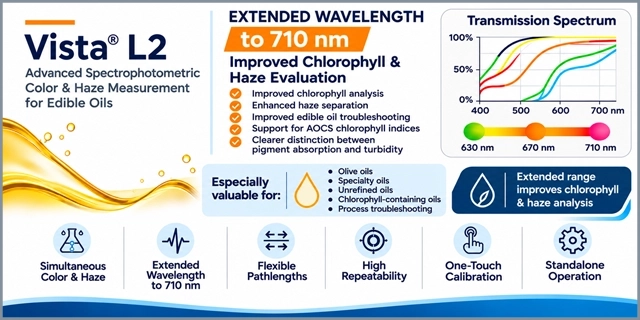
In a single measurement, the HunterLab Vista® L2 spectrophotometer measures chlorophyll-related pigments, liquid color and haze to assess edible oil color and clarity.
Why is chlorophyll measured in edible oils?
Chlorophyll contributes to the green color found in many vegetable oils. Its presence provides information about the raw material and how effectively pigments have been reduced during refining.
Manufacturers use pigment measurements to evaluate incoming oils and assess how effectively refining reduces chlorophyll-related pigments.
Visual inspection can reveal noticeable differences in oil color, but it cannot quantify chlorophyll concentration. Spectrophotometric measurements provide numerical results that laboratories can use for quality grading and batch comparisons.
How is chlorophyll measured in edible oils?
AOCS Cc 13d-55 uses transmission absorbance at 630, 670 and 710 nm to determine the concentration of chlorophyll-related pigments, predominantly pheophytin a, in mg/kg (ppm). It applies to oils within the method's scope, such as refined and bleached oils before deodorization.
The calculation subtracts the average absorbance at 630 and 710 nm from the absorbance at 670 nm to correct for background absorbance.
Use a clear oil sample free of haze, moisture and particulates for this method. If the oil is visibly cloudy or the haze check flags a clarity issue, follow the applicable sample preparation procedure before measuring pigment concentration.
How to measure chlorophyll in edible oils with Vista L2
Oil residue in the sample cell, trapped air bubbles and inconsistent pathlengths can affect absorbance readings. HunterLab recommends the following practices when testing edible oils:
- Select the appropriate chlorophyll measurement method. Configure the instrument according to the required testing procedure.
- Use clean optical cells. Check for oil residue or contamination from previous samples before filling the cell.
- Maintain a consistent pathlength. Use the same optical pathlength when comparing measurements from different oil samples.
- Remove air bubbles. Inspect the filled cell before measurement, as bubbles can interfere with light transmission.
- Standardize the instrument regularly. Follow HunterLab's recommended standardization procedure.
- Measure representative production samples. Collect samples that reflect the oil being evaluated rather than relying on an unrepresentative portion of the batch.