What is the difference between a spectrophotometer and a colorimeter?

A colorimeter reads color through 3 to 4 fixed filters and outputs tristimulus values directly. A spectrophotometer measures the full visible spectrum, usually 400 to 700 nm, and calculates color values from that wavelength data. Storing the full spectral curve lets a spectrophotometer detect metamerism, when two samples match under D65 daylight but not under A incandescent. A colorimeter cannot.

Those two words get used loosely. Precisely, the instruments being compared are a filter-based tristimulus colorimeter and a colorimetric spectrophotometer. "Colorimeter" on its own is the umbrella for any instrument that reports color from the human observer function, so it technically covers both, but in practice people use it for the filter-based type. All HunterLab instruments are colorimetric spectrophotometer.

How instrumental color measurement works

Instrumental color measurement minimizes the subjectivity and variability of human perception and vocabulary and allows us to capture color information as objective data, creating a common language of color that is essential for communication within and between industries around the world, ranging from food and beverage to pharmaceuticals.

A filter-based tristimulus colorimeter uses 3 to 4 filters to simulate how the human eye sees color, outputting tristimulus values without obtaining spectral data. A colorimetric spectrophotometer measures the full visible-light spectrum (typically 400 to 700 nm) and calculates color values (L*, a*, b*, XYZ, or any CIE scale) from wavelength-by-wavelength spectral analysis.

Why metamerism detection matters

A colorimetric spectrophotometer can identify when two samples match under one light source (such as D65 daylight) but not another (such as A incandescent), because it stores the full spectral data across many illuminant and observer combinations. A filter-based tristimulus colorimeter cannot make this distinction. It is restricted to its fixed illuminant and observer condition and has no spectral data to draw on.
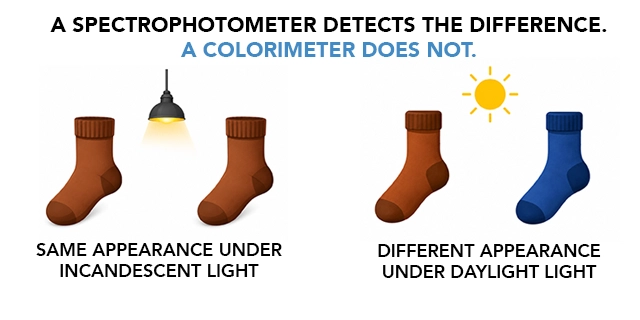
Graphic comparing two brown socks that match under incandescent light and appear brown and blue under daylight.

A filter-based tristimulus colorimeter can handle simple pass/fail QC. A colorimetric spectrophotometer gives you the same colorimetric data plus the spectral data to diagnose why a batch failed, detect metamerism, and support in-depth color analysis, all from one instrument. For any application where color accuracy matters, a colorimetric spectrophotometer is the more future-proof investment.

Not every spectrophotometer measures color

"Spectrophotometer" on its own is a broad category, and not every instrument in it is built for certified color work. All colorimeters can measure color, but most spectrophotometers cannot. Colorimeters meet the specific geometric conditions that color measurement requires. Most spectrophotometers are designed for analytical use. They can measure absorption color, but they are rarely suitable for measuring CIE color. If you are buying a spectrophotometer, you have to confirm it can actually be used for certified color measurement.

The instruments designed for it are called colorimetric spectrophotometers, or spectrocolorimeters. Both instrument types can deliver highly repeatable color measurements. What separates them is that the spectrophotometer keeps the full spectral data and can run the analyses that data makes possible.

While closely related, these instruments have unique qualities that may make one more suitable than the other for a particular type of measurement. Understanding the characteristics of a filter-based tristimulus colorimeter vs. colorimetric spectrophotometer can help you select the best tool for your application.

What Is a Filter-based Tristimulus Colorimeter?

The International Commission on Illumination (CIE) defines a colorimeter as "an instrument for measuring colorimetric quantities, such as the tristimulus values of a colour stimulus." ASTM further distinguishes a tristimulus (filter) colorimeter from a spectrophotometer, or spectrocolorimeter, on the basis that spectrophotometers measure spectral data from which colorimetric values are calculated.

A filter-based tristimulus colorimeter is an instrument for psychophysical analysis that provides measurements correlating with human eye-brain perception by directly reading and providing colorimetric data as tristimulus values (such as XYZ and Lab).

There are a few unique components involved in a filter-based tristimulus colorimeter.

  • Illuminant: The illuminant represents a specific light source, such as daylight or incandescent light, to project consistent brightness onto the object. In a filter-based tristimulus colorimeter, an illuminant is fixed.
  • Observer: The standard observer offers a specific field of view with which to analyze the colors. A filter-based tristimulus colorimeter usually uses a 2-Degree Standard Observer, which is suitable for color evaluation and quality control.
  • Tristimulus absorption filter: Three broad-band optical filters designed to approximate the CIE Standard Observer color matching functions.

Unlike inexpensive consumer RGB sensors, industrial colorimeters are tristimulus instruments, not simple RGB devices. Their optical filters are carefully engineered to approximate human color perception as defined by the CIE, and the instrument reports X, Y and Z rather than R, G and B.

How Does a Filter-based Tristimulus Colorimeter Work?

A filter-based tristimulus colorimeter is a rugged, less complex instrument designed to approximate human visual response. A stable light source illuminates the sample. Reflected or transmitted light passes through three broad-band optical filters, each matched to one of the CIE Standard Observer response curves. Three detectors read the filtered light, the instrument calculates the X, Y and Z tristimulus values, and color spaces such as CIELAB follow from those. The original spectral information is not retained. Only the calculated colorimetric values are kept, and the instrument works under a fixed illuminant and observer combination (typically C/2°).
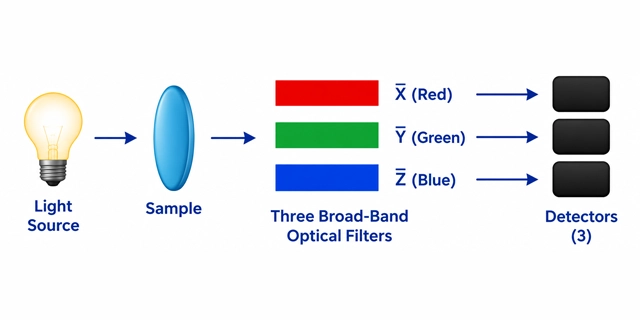
Diagram of how a colorimeter works: light source, sample, three broad-band optical filters labeled X red, Y green, Z blue, and three detectors.

The Pros of Filter-based Tristimulus Colorimeters

  • They focus on tristimulus values. If you don't need full-range spectral data, a filter-based tristimulus colorimeter doesn't have you paying for tools you won't use.
  • They work quickly. Many applications for filter-based tristimulus colorimeters require fast-moving equipment, such as on an assembly line, and a filter-based tristimulus colorimeter can do that.
  • Simple operation.
  • Lower acquisition and maintenance cost for many routine applications.
  • Ideal for production environments requiring rapid pass/fail decisions.

The Cons of Filter-based Tristimulus Colorimeters

  • They don't offer a complete range of spectral data. A filter-based tristimulus colorimeter won't help with determining colorant strength or color formulation.
  • They aren't versatile. Filter-based tristimulus colorimeters lack versatility, as their primary purpose is to compare products to a predefined sample. They aren't well-suited for research or product development applications.
  • They can't identify metamerism. Metamerism occurs when colors look identical in one lighting condition, but not another. Filter-based tristimulus colorimeters can't identify and adjust for this occurrence.

Applications for Filter-based Tristimulus Colorimeters

Typically, the filter-based tristimulus colorimeter compares results to an existing standard. Filter-based tristimulus colorimeters are capable for straightforward color measurement and ideally suited for determination of color difference, as well as routine comparisons of similar colors.

As such, filter-based tristimulus colorimeters can be used for color quality control and are primarily used in the production and inspection phases of manufacturing.

What Is a Colorimetric Spectrophotometer?

A colorimetric spectrophotometer is an instrument designed for physical sample analysis via full-spectrum color measurement. By providing wavelength-by-wavelength spectral analysis of a sample's reflectance or transmittance properties, it produces precise spectral data beyond that observable by the human eye. Using this detailed data, colorimetric spectrophotometers then calculate psychophysical colorimetric information.

The result is a complete spectral fingerprint of the sample. Because the whole spectrum is measured and stored, new color calculations can usually be run later without measuring the sample again.

Many spectrophotometers also extend beyond the visible spectrum into the ultraviolet (UV) and near infrared (NIR) for specialized analytical applications.

Colorimetric spectrophotometers are incredibly precise and offer an expansive range of data. They use similar components to a filter-based tristimulus colorimeter but with slight variations.

  • Illuminant: Any illuminant can be simulated including daylight and fluorescent illuminants that represent various types of light.
  • Observer: The observer of a colorimetric spectrophotometer offers 2° and 10°. CIE recommends 10° as the most appropriate setting for industrial color applications as it better mimics the human observer function.
  • Monochromator: A diffraction grating, prism or interference filter separates the returning light into narrow bands of individual wavelengths.

How Does a Colorimetric Spectrophotometer Work?

A colorimetric spectrophotometer is an objective physical analysis instrument to measure color. A stable light source illuminates the sample. The reflected or transmitted light enters a monochromator, typically a diffraction grating, which separates it into individual wavelengths. A detector array measures light intensity at many narrow wavelength intervals, producing a complete spectral reflectance or transmittance curve. From that curve the instrument calculates the X, Y and Z tristimulus values, which convert to CIE Lab, LCh, Yxy and other scales.
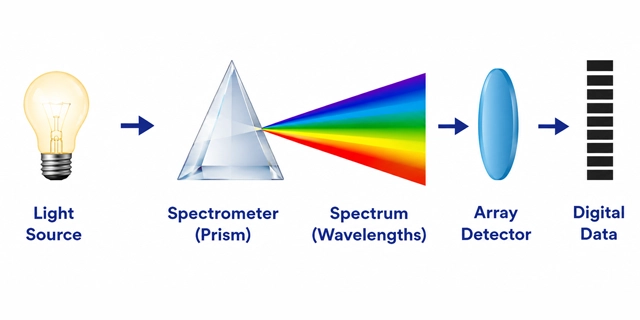
Diagram of a spectrophotometer: light source, prism spectrometer splitting light into a spectrum, array detector, and digital data output.

Pros of a Colorimetric Spectrophotometer

  • They are incredibly comprehensive. A colorimetric spectrophotometer has more advanced hardware and can measure qualities that a filter-based tristimulus colorimeter can't, including spectral data.
  • They are versatile. You can typically adjust illuminant and observer settings to get just the right options on a colorimetric spectrophotometer.
  • They work with powerful software. By integrating with software, colorimetric spectrophotometers offer a comprehensive way to review and analyze data.
  • They come in a variety of styles. Available for a wide array of sample types, including powders, liquids and transparent materials.
  • They offer quick results. Some colorimetric spectrophotometers yield results in as little as two seconds, boosting speed and efficiency.
  • They aid in achieving the desired color. Obtaining the desired color continuously is vital for brand consistency and process control.
  • They are ideal for precise analysis. For research-focused environments where accuracy is paramount, colorimetric spectrophotometers offer in-depth analysis.
  • They can also detect metamerism, determine colorant strength, and help with color formulation
  • Colorimetric spectrophotometers, depending on its specific model and optical geometry, can perform appearance analysis to provide metrics such as opacity, haze, or NTU

Cons of a Colorimetric Spectrophotometer

  • They can be more expensive. Colorimetric spectrophotometers and their broad range of information typically cost more than a filter-based tristimulus colorimeter, though the added capability often justifies the investment for production and R&D environments.
  • Earlier colorimetric spectrophotometer designs were built for controlled lab conditions. Modern instruments are increasingly compact, user-friendly, and designed for production environments.
  • They may exceed simple QC needs. If your only requirement is pass/fail against a single fixed standard with no metamerism risk, a colorimetric spectrophotometer provides more capability than the task requires. For any application likely to grow in complexity, the additional capability is an asset.
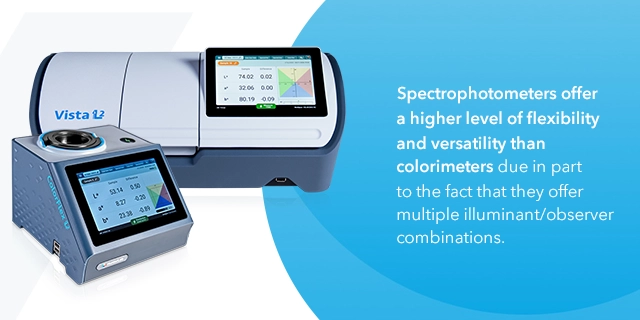
Vista L2 spectrophotometer and ColorFlex L2 spectrohphototmeter, both showing color readings on touchscreen displays.

Applications of Colorimetric Spectrophotometers

Colorimetric spectrophotometers offer a higher level of flexibility and versatility than filter-based tristimulus colorimeters due in part to the fact that they offer multiple illuminant/observer combinations and spectral data. Furthermore, they are available in various models equipped with different optical geometries—such as diffuse (d/8° or d/0°) or directional (0°/45° or 45°/0°)—to suit specific material characteristics. As such, colorimetric spectrophotometers are capable of measuring metamerism, identifying colorant strength, analyzing a comprehensive range of sample types and giving users a choice between including or excluding specular reflectance to account for geometric attributes.

Full-spectrum analysis also provides for greater specificity, potentially identifying color differences missed by filter-based tristimulus colorimeters. Colorimetric spectrophotometers are ideally suited for a broad range of applications in the research and development phase, including color formulation and color system development, as well as color quality control throughout production.

Why Spectral Data Matters in Color Measurement

A colorimetric spectrophotometer measures and stores the complete spectral fingerprint, far more information than the three tristimulus values a filter-based tristimulus colorimeter measures. Because the complete spectrum is available, a single measurement can be used to calculate a wide range of color spaces, color indices, and advanced analytical metrics.

Color spaces

  • CIE L*, a*, b*
  • CIE L*, C*, h°
  • XYZ
  • Delta E

Color indices

  • Yellowness Index (YI)
  • Whiteness Index (WI)
  • APHA
  • Gardner
  • Tint
  • Color Strength
  • Opacity
  • Haze

Advanced analysis

  • Metamerism evaluation
  • Spectral comparison
  • Color formulation
  • Traceability and spectral archiving

Think of the measured spectrum as the sample optical fingerprint. Every reported color value, including CIELAB, Delta E, Yellowness Index, Whiteness Index, APHA and Gardner, is calculated from this spectral fingerprint.

Because the complete spectrum is preserved, the data can be reanalyzed in the future without remeasuring the sample, providing maximum flexibility, traceability, and confidence in your color measurements.

Which color measurement solution does your industry need?
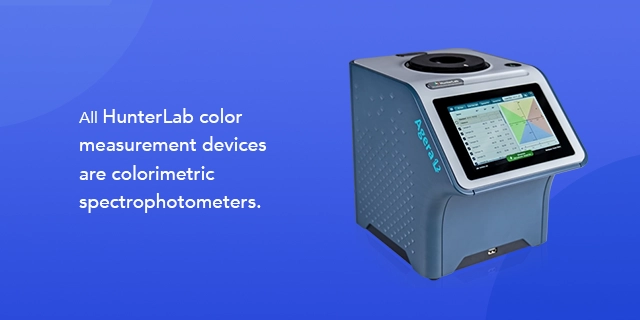
Agera L2 spectrophotometer with a color plot displayed on its onboard touchscreen.

All HunterLab color measurement devices are colorimetric spectrophotometers. The right choice comes down to your sample type, your tolerance requirements, and whether you need spectral data for reformulation or in-line process control.

Industry / application HunterLab instrument Key features
Food and beverage, pet food: powders, liquids, dairy, sauces ColorFlex® L2 Touchscreen; built-in camera for sample preview; measures opaque solids, liquids, powders, granules, and pellets, plus translucent solids and liquids; live camera preview; onboard EasyMatch Essentials L2 with no separate PC
Beverages, oils, transparent liquids, plastic preforms Vista® L2 Measures color and haze/NTU simultaneously in a single transmission read; onboard EasyMatch Essentials L2 with no separate PC
Plastics or recycled plastics, packaging films, coatings, paints, textiles, paper, petrochemicals, pharmaceuticals, dark and low-reflectance materials Agera® L2 Certified Grade 'A' CIE D65 illumination with controlled UV; color and 60° gloss in one read; live camera preview; onboard EasyMatch Essentials L2 software with no separate PC; Dark Performance Mode resolves dark and low-reflectance samples
Food and beverage: snacks, nuts, non-homogenous textures Aeros® Non-contact instrument; automatic height positioning; minimal sample preparation required; result in about five seconds; 35 measurements per rotation
In-line process control: bread, nuts, snack food SpectraTrend® HT Continuous non-contact monitoring; flags off-color batches instantly; closes the gap between the line and the QC lab
Solids and liquids: reflectance and transmission UltraScan® VIS Measures reflectance, transmittance, and haze/NTU; wavelength range 360 nm to 780 nm; 10 nm optical resolution and reporting interval; two reflectance measurement areas; automated UV calibration and control;
High-precision research and QC: transparent and opaque UltraScan® PRO Measures reflectance, transmittance, and haze/NTU; automated specular include or exclude; spectral range 350 nm to 1050 nm, full CIE visible range plus NIR; automated UV calibration and control; 5 nm reporting interval
Meats, poultry, fish, produce: portable or multi-line MiniScan® EZ Handheld; available in directional 45°/0° and diffuse d/8° geometries; measures product the way customers see it

Not sure which instrument fits your process? Talk to a HunterLab color measurement specialist.
読む  分光測色法の課題:高温の液体試料を扱う

Factors to Consider When Purchasing Colorimetric Spectrophotometers

  • Budget: Determining your budget is important, as differently priced colorimetric spectrophotometers have various features.
  • Lab space: Consider if you'll need a portable or benchtop device for your experiment's goals.
  • Specifications: Get a colorimetric spectrophotometer that tests materials according to the scope and depth you'll need, such as wavelength ranges and detection limitations.

Still deciding between a colorimetric spectrophotometer and a filter-based tristimulus colorimeter?

HunterLab has helped color quality teams in food, plastics, textile, and pharma select the right instrument for over 70 years. Tell us your material, your tolerance, and your workflow — we'll recommend the right geometry and model.

✓  Free instrument selection consultation

✓  Application-specific accuracy benchmarks

✓  Customized demo or sample measurement available

Talk to a color measurement specialist

インフォメーション  詳細情報

Colorimetric Spectrophotometer vs Filter-based Tristimulus Colorimeter: technical specifications compared

Specification Filter-based Tristimulus Colorimeter Colorimetric Spectrophotometer
Measurement principle An instrument for psychophysical analysis – provides measurements that correlate with human eye-brain perception An instrument for physical analysis— provides wavelength-by-wavelength spectral analysis of the reflecting or transmitting properties of objects without interpretation by a human.
Spectral data No Yes — full spectral data and spectral curve archived per measurement
Output Tristimulus color values (Lab, XYZ, etc) only Tristimulus color values and spectral data
Metamerism detection No — single fixed illuminant Yes — Metamerism Index calculated across multiple illuminants with spectral data
Illuminant/Observer Typically one fixed illuminant/observer set Any CIE illuminants and standard observers, switchable after measurement
Fluorescence measurement No Available— UV component can be quantified separately
Repeatability Good for pass/fail QC Excellent — capable of detecting very small color shifts
Typical application Pass/fail QC at production speed Formulation, shade matching, metamerism, QC, regulatory submission, R&D
Cost Lower Mid to premium depending on specification

Choosing the Best Color Measurement Device for Your Application

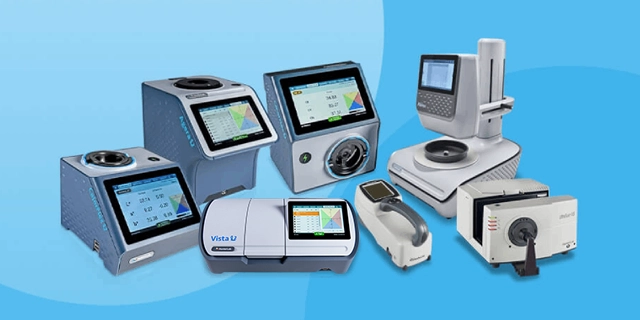
HunterLab spectrophotometer lineup on a blue background, including benchtop, handheld, and non-contact instruments.

Choosing a color measurement instrument requires an understanding of the advantages and disadvantages of both filter-based tristimulus colorimeters and colorimetric spectrophotometers. If you are still uncertain about which instrument is best for your purposes, these questions can help you gain clarity:

  • Type of data required: Does the application require spectral data or tristimulus values only?
  • Instrument geometry: Does the application requires a specific optical geometry?
  • Precision and accuracy: What level of precision and accuracy are necessary for satisfactory results?
  • Illuminants: Does the instrument have an appropriate illuminant available for your application?
  • Rapidity of measurement: How quickly can data be obtained? What kind of sample preparation is required?
  • Ease of use: Is the instrument designed with the user in mind, facilitating simple and rapid operation?
  • Robustness: Is the instrument appropriate for the environment in which it will be used? Can it withstand harsh factory conditions?
  • Software interface: Does the accompanying software allow you to easily collect, analyze and share data?
  • Can your product QA benefit from Inter Instrument Agreement (IIA)?
  • Product quality: Not all color measurement instruments are created equal. By selecting the best quality instrument, you can be assured that you will obtain the highest quality results.

Should You Choose a Colorimeter or a Colorimetric Spectrophotometer?

A filter-based tristimulus colorimeter may be the right choice when:

  • Routine pass/fail decisions are required
  • Measurements are straightforward
  • Speed and simplicity are priorities
  • Spectral analysis is unnecessary

A colorimetric spectrophotometer is the better choice when:

  • Advanced color analysis and flexibility are required
  • Products are evaluated under multiple lighting conditions
  • Color formulation is performed
  • Metamerism must be evaluated
  • Regulatory traceability is important
  • Color data must support research and development
  • Future flexibility is desired

For most industrial applications where color consistency, supply chain communication, or regulatory compliance is required, a colorimetric spectrophotometer is the better fit. Both instrument types can provide repeatable color measurements. The difference is the retained spectral data, which supports metamerism evaluation, color formulation, illuminant simulation, and traceability. For applications requiring maximum flexibility, traceability, and advanced color analysis, a colorimetric spectrophotometer provides the most comprehensive solution.

Industry Standards for Color Measurement

Color measurement terminology and methodology are defined by internationally recognized standards:

  • CIE S 017, International Lighting Vocabulary
  • ASTM E284, Terminology of Appearance
  • ASTM E1347, Tristimulus (Filter) Colorimetry
  • ASTM E2214, Spectral Measurement of Color

HunterLab instruments are designed to support internationally recognized color measurement practices and industry standards.

1. What is the difference between a colorimeter and a spectrophotometer?

Broadly, a colorimeter is any instrument that measures color based on the Human Observer function, which covers both filter-based tristimulus colorimeters and colorimetric spectrophotometers. HunterLab describes its instruments as both colorimeters and spectrophotometers for that reason. So when people ask about colorimeter vs spectrophotometer, the real comparison is between two branches of the same family: the filter-based tristimulus colorimeter and the colorimetric spectrophotometer. A filter-based tristimulus colorimeter uses three or four filters to read color the way the eye does, and it outputs tristimulus values (L*, a*, b* or XYZ) directly. A colorimetric spectrophotometer measures the full visible-light spectrum — typically 400 to 700 nm — and calculates color values (L*, a*, b*, XYZ, or any CIE scale) from wavelength-by-wavelength spectral analysis. It also stores spectral data, can detect metamerism, support color formulation, and recalculate under different illuminants after the reading. A filter-based tristimulus colorimeter holds no spectral data, so it handles pass/fail comparison and stops there. All HunterLab instruments are colorimetric spectrophotometers.

2. What does a colorimetric spectrophotometer measure?

A colorimetric spectrophotometer measures the reflectance or transmittance of a sample across the visible range, roughly 400 to 700 nm. From the spectral data it calculates color values (CIELAB,XYZ, Hunter Lab), plus Delta E total color difference and a metamerism index across illuminants. On transmission-capable models such as the Vista L2, UltraScan VIS, and UltraScan PRO, it also measures haze and turbidity in the same measurement. Because it records the complete spectral data, it can help color formulations and predict how a sample will look under different light sources. A filter-based tristimulus colorimeter captures none of that spectral detail.

3. What does a filter-based tristimulus colorimeter measure?

In everyday use, colorimeter usually means a filter-based tristimulus colorimeter, so that is the instrument described here. It passes light through three or four filters that mimic the human vision, and it reports tristimulus values, usually XYZ. The design is built for pass/fail quality control. It tells you whether a sample matches your target. It cannot detect metamerism, and does not support formulation.

4. How does a colorimetric spectrophotometer work?

A colorimetric spectrophotometer directs light at a sample and separates the reflected or transmitted light into narrow wavelengths using a diffraction grating, prism, or interference filter. This wavelength-by-wavelength analysis produces highly precise spectral data regarding the sample's optical properties. Software converts the spectral data into tristimulus color values such as XYZ or L*, a*, b*, calculates Delta E total color difference against a reference. Colorimetric spectrophotometers helps detect metamerism,  determinecolorant strength, and color formulation. A sphere (d/8°) geometry treats surface texture differently than a directional (45°/0°) geometry, so the geometry you choose follows the material in front of you.

5. How does a filter-based tristimulus colorimeter work?

A filter-based tristimulus colorimeter is a less complex instrument designed to approximate human visual response . It works by passing light through three or four wide-band tristimulus absorption filters which isolate broad bands of wavelengths. Because of this physical design, the instrument operates under a fixed illuminant and observer combination (typically C/2°). A simple internal processor then analyzes the data and instantly outputs it as direct tristimulus values, such as XYZ or L,a,b. The fixed setup is why a filter-based tristimulus colorimeter cannot switch illuminants for a reading, and why it cannot detect metamerism.

6. What is a spectral fingerprint?

A spectral fingerprint is the complete spectral reflectance or spectral transmittance record of a sample, measured at many individual wavelengths across the visible spectrum. Because the complete spectrum is measured and stored, new color calculations can often be performed later without remeasuring the sample. Every reported color value, including CIELAB, XYZ and Delta E, is calculated from that fingerprint.

7. Why is spectral data important?

Spectral data allows color to be recalculated under different illuminants, supports metamerism evaluation, enables color formulation, and preserves the sample complete optical fingerprint for future analysis. From one measurement the software can calculate CIELAB, XYZ, Delta E, Yellowness Index, Whiteness Index, APHA, Gardner, Tint and Color Strength.

8. Does a colorimeter measure RGB?

No. Industrial colorimeters are not RGB sensors. They use three broad-band optical filters engineered to approximate the CIE Standard Observer, and they report X, Y, and Z tristimulus values, from which CIELAB and other color spaces are calculated.

9. Is a spectrophotometer more accurate than a colorimeter?

Both instrument types can deliver highly repeatable color measurements. The difference is that a colorimetric spectrophotometer retains complete spectral data, which enables analyses that tristimulus values alone cannot support.

10. Can a colorimetric spectrophotometer replace a filter-based tristimulus colorimeter?

Yes. Colorimetric spectrophotometers can provide tristimulus color data and go beyond that. They offer more than one illuminant/observer combination, can provide spectral data, detect metamerism and help with color formulation.

11. When do you need a colorimetric spectrophotometer instead of a filter-based tristimulus colorimeter?

Choose a colorimetric spectrophotometer when any of these apply: your product contains optical brighteners or fluorescent components, your samples have metamerism risks, your supply chain spans multiple sites or suppliers who compare color data, you need to formulate or match a color, your industry complies to ASTM, ISO, or CIE requirements, or you archive spectral data to track color over time. A filter-based tristimulus colorimeter fits only when none of those apply and you need nothing beyond simple pass/fail against one fixed standard under steady lighting.

12. What is metamerism in color?

Metamerism is when two samples match under one light source and do not match under another. Textile dyers, for example, measure metamerism to ensure that the fabric used for shirt sleeves matches that used for shirt bodies under indoor fluorescent and incandescent lighting, as well as outdoor natural daylight. It happens because the two samples have different spectral reflectance curves that land on the eye the same way under one illuminant and differently under the next. A colorimetric spectrophotometer catches this by capturing spectral data and calculating a metamerism index across illuminants. A filter-based tristimulus colorimeter cannot, which is why plastics, automotive, textile, and coatings teams with tight color matching rely on colorimetric spectrophotometers.

13. Can a colorimeter detect metamerism?

Limited. A filter-based tristimulus colorimeter measures only the final colorimetric values and does not retain spectral information, so it cannot fully support metamerism evaluation. A colorimetric spectrophotometer measures and stores the complete spectrum, which is what allows metamerism to be evaluated across illuminants.

14. How do you measure color objectively?

Objective color measurement starts with a standardized instrument, either a filter-based tristimulus colorimeter or a colorimetric spectrophotometer, that reports color as numbers rather than opinion. The instrument lights the sample, reads the reflected or transmitted light from the sample, and outputs tristimulus color values such as L* for lightness, a* for the red-green axis, and b* for the yellow-blue axis in CIE L*a*b* space. Delta E then expresses the total color difference which is how far a sample sits from its target. For most industrial work a colorimetric spectrophotometer is the stronger choice, since the full spectral data supports diagnosis and formulation rather than measurement alone, and it gives suppliers and customers one shared set of numbers to work from.

15. Which colorimetric spectrophotometer should I use for plastics, recycled materials, coatings, textiles, and dark or low-reflectance samples?

Every HunterLab instrument is a colorimetric spectrophotometer, and for plastics, recycled plastics, packaging films, safety materials, textiles, coatings, paper, petrochemicals, and pharmaceuticals, the Agera® L2 is built for the job. It reads color and 60° gloss (ASTM D523 / ISO 2813) in a single measurement, under certified Grade 'A' CIE D65 illumination with controlled UV, from a compact benchtop footprint. A live camera preview confirms sample positioning before you measure, and onboard EasyMatch Essentials L2 runs the instrument with no separate PC. Its Dark Performance Mode is designed for dark and low-reflectance, capturing the spectral detail a filter-based tristimulus colorimeter cannot resolve. That detail is what lets it feed computer color matching for formulation, flag fluorescent brightener shifts, and hold color consistency across a complex supply chain.

16. Which instrument should I use for measuring color in food and beverages?

The right pick depends on the sample. For powders, pellets, dairy, sauces, and spices, the ColorFlex® L2 gives you a touchscreen, no separate computer, a built-in camera for sample preview, and support for opaque solids, liquids, powders, granules, and pellets, which suits line-side QC. For snacks, nuts, and non-homogenous textures, the Aeros® measures the surface without contact, requires minimal sample prep, and returns a result in about five seconds. For transparent and semi-transparent beverages and oils, the Vista® L2 measures color and NTU  in a single read. For portable spot checks on meats, poultry, fish, and produce, the MiniScan® EZ brings handheld 45°/0° geometry that sees product the way a customer does.

17. What is the best colorimetric spectrophotometer for in-line production color control?

For continuous color measurement on a running line, especially bread, nuts, and snack food, the SpectraTrend® HT is built for non-contact process control. It reads color continuously, flags off-color batches as they happen, and closes the lag between production and a QC lab result.

18. How do you standardize a colorimetric spectrophotometer?

Instrument standardization sets the Bottom of Scale (0% line) and Top of Scale (100% line). It usually runs in two steps: a zero (black) reading using a black glass or a light trap to record the instrument's response with no return light, then a reading against a certified calibrated white tile. It is recommended to standardize the instrument every 8 hours, changing operators or measurement modes, swapping accessories, and lab environment changes. . HunterLab software walks the operator through each step of standardization. 

HunterLab Color Measurement

At HunterLab, we have been pioneers in the field of color measurement for over 70 years. We offer a comprehensive range of modern colorimetric and spectrophotometric instruments designed to meet the versatile needs and exacting standards of our customers across industries whether in the field, the lab or on the factory floor.

Our commitment to continuous innovation and technological excellence has led to the development of the highest-quality colorimeters, spectrophotometers and software products available on the market today, expanding the possibilities of color analysis, formulation and quality control.

Contact us to learn more about our color measurement instruments, customizable software packages and dedicated customer support services, and let us help you select the right tools for your applications. You can also request a quote today, and one of our experts will assist you in finding a colorimetric spectrophotometer suitable for your laboratory needs.