cPat

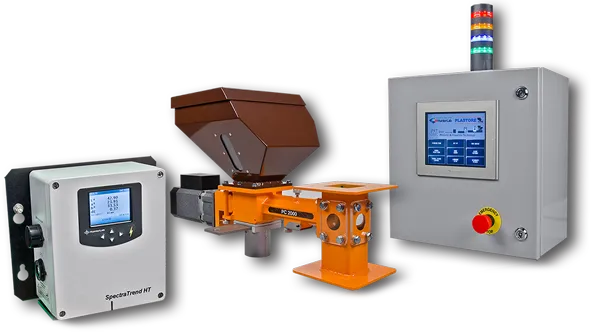
Color Process Automation Technology (cPAT) color measurement and control apparatus

Real time color monitoring. Closed-loop color control. Automated downstream defect containment.

From plastic sheet manufacturing, to window profile, vinyl siding, custom profile and compounding, cPAT offers best practices and automated solution tools to improve manufacturing efficiencies, ensure product quality, and reduce overall costs. cPAT for plastics manufacturing moves the production color QC process from one of time-interval based color measurements and manual adjustments to one of real-time color monitoring, automated closed-loop color control, and automated defect containment. Benefits include Reduced operational costs, Process Yield Improvements, Cost Reduction through Material savings, Improve Operator Efficiencies, Improved Equations for Green Initiatives and Carbon Footprint Reductions, Improved Customer Satisfaction & Improved shareholder/stakeholder value.

Explore all the additional features and benefits below.

Measurement

Measurement Principle: Dual-beam in-line/in-process spectrophotometer

Geometry: 0°/ 30° typical

Spectrophotometer: Sealed optics; 256-element diode array; high resolution concave holographic grating

View Diameter: 25.4 mm (1 in) (at 3.5-inch from sensor window)

Specular Component: Excluded

Spectral Range: 400 nm - 700 nm

Spectral Resolution: < 3 nm

Effective Bandwidth: 10 nm equivalent triangular

Reporting Interval: 10 nm

Photometric Range: 0 to 150 %

Light Source: Full spectrum, balanced solid state LED system

Flashes per Measurement: 5-6 flashes

Lamp Life: 5 years typical

Minimum Interval between Measurements: 1 second

Height Resolution: 1 mm or 0.1 in

Working Range: 65 mm - 115 mm (2.5 in. - 4.5 in.)

Performance

Inter-Instrument Agreement:

  • ∆E*< 0.30 CIE L*a*b* (Avg) on BCRA II Tile Set
  • ∆E*< 0.50 CIE L*a*b* (Max) on BCRA II Tile Set Colorimetric

Repeatability (20 Readings): ∆E*< 0.05 (Max)/0.03 (Avg) CIE L*a*b* on white tile

Firmware

Data Views: Color Data, Color Difference Data, Tristimulus Color Plot, Spectral Data, Spectral Difference Data, Spectral Plot, Spectral Difference Plot

Other Features: Pass/Fail, Average Multiple Readings

Illuminants: A, C, D50, D55, D65, D75, F2, F7, F11

Observers: 2° and 10°

Color Scales: CIE L*a*b*, Hunter Lab, CIE L*C*h, CIE Yxy, CIE XYZ

Color Difference Scales: ∆L*a*b*, ∆Lab, ∆L*C*H, ∆L*C*h, ∆Yxy, ∆XYZ

Color Difference Indices: ∆E*, ∆E, ∆C*, ∆C and ∆E CMC

Indices and Metrics: E313 Whiteness Index, Tint, E313 Yellowness Index, D1925 Yellowness Index, Y Brightness, Z%, 457 nm Brightness, Baking Contrast Units, Colorant Strength (Average and Single Wavelength), Gray Change, Gray Stain, dc*, dc, Metamerism Index, Shade Number

Data Storage: As Standard - 250 spectral or tristimulus with Pass/Fail tolerances as Working, Physical, Numeric and Hitch

Languages: Chinese, English, French, German, Italian, Japanese, Spanish

Physical/Electrical

Sensor Dimensions:

  • Height: 24 cm (9.3 in.)
  • Width: 20 cm (7.8 in.)
  • Depth: 11 cm (4.3 in.)
  • Weight: 4.5 kg (9.9 lbs)

Support Unit Dimensions:

  • Height: 25.4 cm (10 in.)
  • Width: 20.3 cm (8 in.)
  • Depth: 16.5 cm (6.5 in.)
  • Weight: 6.75 kg (15 lbs)

Display: 7.1 cm x 5.4 cm (2.8 in. x 2.1 in.) backlit color LCD

Interface: Ethernet (RJ45)

Power: 100 to 240 VAC, 47 to 63 Hz

Operating Environment: 0° to 50°C (32° to 122° F), 10 % to 90 % RH, noncondensing

Storage Environment: -20° to 65°C (-5° to 150° F), 10 % to 90 % RH, noncondensing

Standard Accessories:

  • Calibrated instrument white tile
  • Certificate of Traceability
  • Black glass
  • Green diagnostic tile
  • Calibration Box
  • 20 m Ethernet Cable
  • 10 m Sensor Power & DIO Cable
  • Crossover Adaptor
  • SpectraTrend HT User guide

Connect

We've worked with thousands of companies, but you'll feel like our one and only.

If color accuracy is crucial to your business, you’ve come to the right place—with the right people. Let’s get in touch.

Contact Us