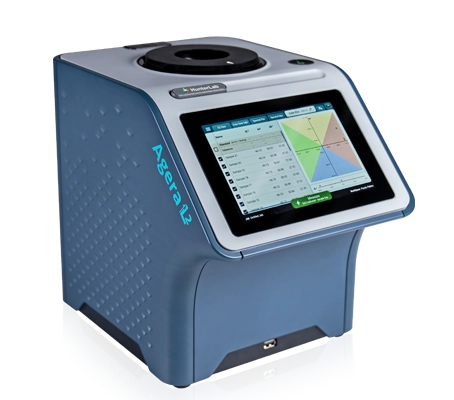
Agera L2
Learn More
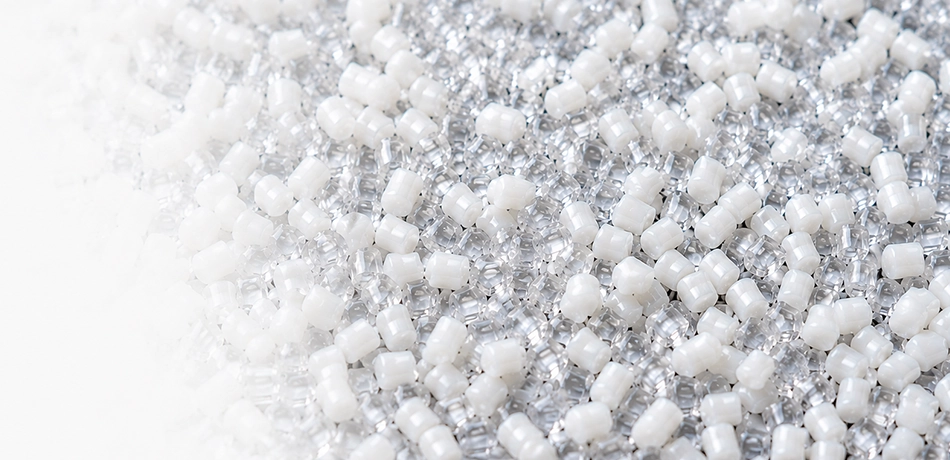
Virgin plastic pellet color measurement helps manufacturers verify production against established standards, monitor lot-to-lot consistency, and identify color shifts before the resin moves into finished-product manufacturing.

THE CHALLENGE
Even with a controlled production baseline, the physical and optical properties of plastic pellets can make repeatable color measurement challenging.

Differences in pellet shape, position, and orientation affect light interaction and can influence color readings.
Measuring a larger sample area reduces the influence of individual pellets and better represents the production lot.
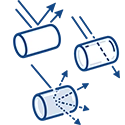
Pellets reflect, transmit, or scatter light differently depending on opacity, requiring appropriate measurement methods.
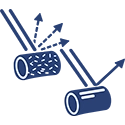
Variations in pellet texture and gloss affect light reflection. Consistent sample preparation improves measurement repeatability.
Color Control Starts with the Pellet: Find color shifts before the resin enters molding, extrusion, or other conversion processes.
THE SOLUTION
HunterLab offers solutions for laboratory QC and continuous production monitoring.
Agera L2 is built for repeatable color measurement of plastic pellets. Its large port plate and extra-large area of view (4–16× larger) measures more pellets with each reading, minimizing the effect of how individual pellets are positioned in the cup. This helps QC teams get closely aligned results when the same material is refilled and measured multiple times.
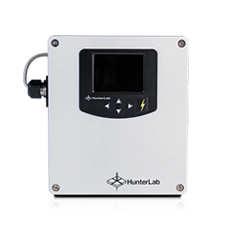
SpectraTrend HT provides non-contact, in-line color measurement for continuous production monitoring.
| Features | Agera L2 | SpectraTrend HT |
|---|---|---|
| Best For | Virgin plastic pellets including opaque and transparent pellets, resins, plaques, molded parts and other opaque plastic samples, rPET | Continuous plastics production |
| Key Benefits | Extra-large area of view(4-16x); reference-grade 0°/45°c precision; Grade A CIE D65 illumination with controlled UV for fluorescent and optically brightened plastics | Non-contact, in-line measurement that detects color deviations in real time to reduce waste and improve process control |
| Indices / Color Data | CIE L*a*b*, ΔE, Yellowness Index, Whiteness Index and custom indices | Continuous spectral color data with real-time ΔE, CIE L*a*b*, and application-specific metrics |
HunterLab is ISO 9001:2015 certified and our products are individually CE certified.
Explore the brochures for key features and benefits. Or bring us your product, and a color specialist will help you find the right fit.
Best Practice: Keep the sample container, fill depth, sample quantity, instrument settings, and testing procedure the same from lot to lot.
See the complete Agera L2 measurement workflow in action and learn how objective color data can be used to evaluate recycled plastic pellets, compare results, and assess the influence of optical brighteners.

The spectrophotometer should match the optical properties of the resin and account for pellet orientation and sample variability. For opaque and transparent virgin plastic pellets, Agera L2’s 0°/45° circumferential geometry and extra-large measurement area are designed to provide accurate and repeatable color measurements.
CIE L*, a*, b* values measure lightness and color direction, while ΔE* shows the overall color difference from an approved standard. Yellowness Index (YI) E313 and Whiteness Index (WI) E313 may also be used when required by the resin specification. These color scales and indices are built into Agera L2 for direct measurement and analysis.
Repeatability helps manufacturers confirm that a color difference comes from the material, not pellet positioning in the sample cup. Agera L2’s extra-large viewing area measures more pellets at once, reducing sampling variation and supporting more reliable QC decisions.
Measuring pellets before conversion helps manufacturers verify that the resin meets its color specification before additional processing. This allows an off-spec lot to be identified and reviewed before it enters molding, extrusion, or another production process, saving time and money.
Virgin resin is produced from controlled raw materials using a defined manufacturing process, generally providing a more consistent starting point for color measurement. Recycled resin can show greater color variation due to its previous processing, use, and reprocessing. Both virgin and recycled resin may contain optical brightening agents (OBAs). In recycled resin, these additives may remain from the original material and affect its measured color and appearance under UV-containing light. Agera L2 is designed for repeatable color measurement of both virgin and recycled plastic pellets.