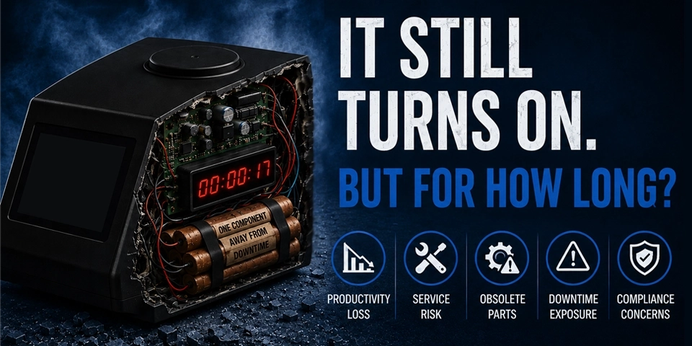
We hear it in nearly every conversation: “My current instrument still seems to work. Why should I replace it?”

It's a fair question. A color spectrophotometer that's run for 15 or 20 years has more than earned its keep. But here's the uncomfortable part: an instrument can keep printing numbers long after it stops printing trustworthy, defensible, low-cost ones. “It still turns on” and “it's still serving the business” are not the same sentence.

Here's the quiet truth about an instrument engineered in the late 1990s: every measurement still depends on a legacy flash lamp and electronics, 12-volt and lamp power supplies, vintage circuit boards, and IC chips that haven't been manufactured in years. It works, until one morning it doesn't, usually the morning a release is waiting on your reading.  Upgrading isn't only about better color data. It's about not being one aging componentaway from a stopped line, with no spare on the shelf and no quick fix in sight.

This is actually the door to every factor that decides an upgrade purchase: lifecycle, productivity, compliance, supportability, standardization, labor, risk, and ROI. Walk through it the right way and you don't just answer your own doubt. You walk into the budget meeting with a case that's already won.

This guide gives you the questions management will ask, and the language to answer them.

Key Takeaways

  • “Still functioning” and “still fit for purpose” are different sentences, and the gap between them is where your hidden costs live.
  • The cases that win speak management's language: ROI, risk, compliance, and standardization. Dollars and exposure, not specs.
  • The real risk isn't the upgrade. It's waiting: lost software/parts support, drift, failed audits, and customer disputes that keep growing.
  • Don't walk in with an opinion. Walk in with numbers. Use the Upgrade Justification Checklist to build them first.

Why "It Still Works" Isn't the Whole Story

An instrument can keep producing numbers long after it stops producing trustworthy, defensible, low-cost numbers. The questions worth asking aren't about whether it powers on, they're about what it's quietly costing you:

  • What is the expected lifecycle of a color measurement instrument, and where is mine in it? Like any precision instrument, a spectrophotometer has a service life. Past it, drift, repair frequency, and uncertainty climb.
  • What happens when software or parts are no longer supported? When an aging platform reaches end-of-support, a single failed component or an OS update can take the instrument, and your quality line, offline with no clear path back.
  • What are the risks of continuing to use an aging instrument? Measurement drift, inconsistent results, audit findings, and an inability to meet tightening customer or regulatory tolerances.

The honest reframe: the question isn't “why replace something that works?” It's “what am I risking, and spending, by waiting?”

Want to know exactly where your current instrument stands? Talk to a HunterLab specialist, no obligation. We'll help you benchmark its lifecycle, supportability, and the real cost of leaving it in service.

読む  色の許容度とは何ですか? なぜ重要なのですか?

The Questions Management Will Ask, and How to Answer Them

When you bring an upgrade forward, leadership evaluates it as a business investment. Be ready for these:

How do I justify the ROI of a new spectrophotometer?

Frame it around money saved and earned, not features: reduced rework and scrap, less labor per measurement, fewer customer returns, and a defined payback period. The Upgrade Justification Checklist gives you the fields to fill in.

How can better color measurement reduce waste, rework, and complaints?

Tighter, more repeatable measurements catch out-of-spec product earlier and reduce disputes over whether a batch passes, cutting scrap, re-runs, and the cost of shipping the wrong color.

What are the hidden costs of poor color control?

They rarely show up on one line item: rework hours, expedited reshipments, scrapped lots, customer concessions, lost shelf space, and the staff time spent arbitrating color disagreements.

How does this improve consistency across multiple sites?

Strong instrument-to-instrument agreement means every lab, line, and location reads the same color, so a “pass” in one plant is a “pass” everywhere, and suppliers and customers speak one color language.

How much productivity do companies gain by upgrading?

Modern workflows, touch-based software, onboard computing, simultaneous measurements, automated reporting, cut steps and training time out of every measurement, compounding across thousands of readings a year.

Don't Pinch an Opinion. Present a Case.

The teams that get a confident “yes” are the ones who put numbers to these questions before the budget meeting, not during it. That's exactly what the checklist does for you.

Free resource: Download the Color Instrument Upgrade Justification Checklist, a one-page worksheet covering lifecycle, ROI, risk, compliance, and standardization, with fields for your own numbers. Walk in ready to defend every line.

And you don't have to build the case alone. HunterLab helps customers size up their installed base, put a dollar figure on staying put, and plan a smooth, well-supported transition.

Book a no-obligation consultation. Let's turn “it still works” into a decision you can stand behind, and defend.

Experience Next-Gen Color Measurement: The HunterLab L2 Family

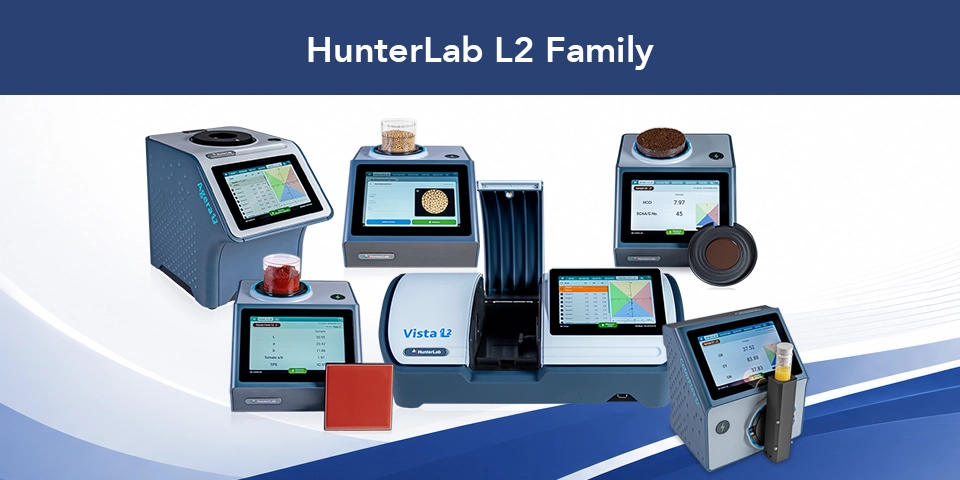
Agera L2, ColorFlex L2, Vista L2 Color Spectrophotometers

There's a moment the first time you run a sample on an L2 instrument. The screen lights up. You touch, you measure, and in seconds you have your answer. No external PC. No waiting. No second-guessing. Just color, the way your eye sees it, with a confidence the instrument on your bench today simply can't give you.

This is what it feels like to work with the best in the industry.

For more than 70 years, HunterLab has done one thing: advance the science of color measurement. That experience now lives across a whole next-generation line, the L2 family, so whatever you measure today has a clear path forward:

  • ColorFlex EZ to ColorFlex L2: the next generation of the benchtop favorite for food, beverage, and everyday QC color.
  • Vista to Vista L2: the modern evolution of transmission color haze, and NTU measurement for clear liquids and transparent materials.
  • LabScan XE to Agera L2: reference-grade 0°/45° reflectance color for plastics, coatings, and your most demanding opaque samples, and anything with 20% reflectance or less

Whichever path is yours, you're not taking a small step over what came before. You're moving a generation ahead.

Every L2 instrument is built to give you:

  • Answers in seconds, not minutes with a self-contained touchscreen workstation, no external PC to boot, manage, or maintain.
  • Numbers you can defend with modern optics and stable illumination that hold their calibration over time.
  • Standardization across every site so a pass in one lab is a pass everywhere, and suppliers and customers read the same color.
  • Less training, faster onboarding with an interface your team learns in minutes, not days.
  • A future-proof platform backed by the company that has led color measurement for more than 70 years.

One Workflow Across the Family: Essentials L2 Software

What ties the L2 family together is Essentials L2, the industry's most advanced color measurement software, built right into the instrument. The same modern experience whether your team is running a ColorFlex L2, a Vista L2, or an Agera L2, so standards, training, and data feel consistent across every bench and every site.

Essentials L2 gives you:

  • No external PC with onboard PC computing power and storage for millions of measurements.
  • A touch-optimized interface that supports fast decisions with minimal training, while keeping advanced capabilities ready when you need them.
  • Consistent results across instruments and sites for true multi-location standardization.
  • Cleaner data and reporting with pass/fail indication, time and date stamping, and auto-saving built in.
  • Connectivity that fits your systems for export and integration with your existing quality and production workflows.

And it feels that way to use. Your aging instrument makes you work for your numbers, juggling a PC and a workflow built for a different era. The L2 family gives the numbers back to you, faster, cleaner, and more trustworthy, on a touchscreen built for how your team actually works. Operators need less training. Your data tells a clearer story. Your customers stop arguing about whose reading is right, because yours is the one everyone can trust.

That is the real advantage of moving forward while your competitors stand still. While they defend aging equipment and explain away drift, you measure with next-generation precision, standardize across every site, and answer color questions before they become disputes. The gap compounds quietly, reading by reading, lot by lot, quarter by quarter.

Next-gen color measurement isn't about owning the newest device. It's about how it feels to stop fighting your instrument and start trusting it, and to know the company behind it has been leading this field longer than anyone. That feeling has a name: confidence. And it's the one thing an aging instrument can never give you back.

Ready to feel the difference for yourself? Schedule a demo and run your own samples on the HunterLab L2 family instrument that fits your lab.

インフォメーション  詳細情報

Frequently Asked Questions

Why should I replace a color measurement instrument that's still working after 15–20 years?

Because “working” and “fit for purpose” differ. An aging instrument can still produce readings while accumulating drift, repair costs, support risk, and an inability to meet tightening tolerances, all of which carry real cost.

How do I justify replacing a colorimeter that hasn't failed yet?

Build the case on ROI and risk rather than failure: rework and scrap reduction, labor savings, reduced customer complaints, compliance, multi-site standardization, and the risk of unplanned downtime once support ends.

What happens when software or parts are no longer supported?

End-of-support means a single failed part or software incompatibility can take the instrument offline with no sanctioned repair path, putting your quality operation at risk. Planning ahead avoids an emergencyreplacement.

What are the hidden costs of poor color control?

Rework and scrap, expedited reshipments, customer concessions and returns, lost retail/brand trust, and staff time spent resolving color disputes, costs that rarely appear on a single line but add up quickly.

How does upgrading improve consistency across multiple manufacturing sites?

Newer instruments with strong inter-instrument agreement ensure every site measures color the same way, so quality decisions are consistent across plants and aligned with suppliers and customers.

What makes the HunterLab L2 family next-generation color measurement?

The L2 family (ColorFlex L2, Vista L2, and Agera L2) combines modern optics with Essentials L2, the industry's most advanced color software, built into each instrument. You get a self-contained touchscreen workstation with onboard computing power, fast reads, and a consistent workflow across every bench, no external PC required.

Which L2 instrument should I upgrade to?

It depends on what you measure. ColorFlex EZ users move to the ColorFlex L2 for portable, benchtop reflectance color; Vista users move to the Vista L2 for transmission color,  haze and NTU on clear liquids and transparent materials; and LabScan XE users move to the Agera L2 for reference-grade 0°/45° reflectance with Certified Grade ‘A’ CIE D65 source illumination on fluorescent and opaque samples. HunterLab can help you confirm the right fit.

Why choose HunterLab over other color measurement brands?

HunterLab has led the science of color measurement for more than 70 years. That experience is built into the entire L2 family and backed by the HunterLab Promise of expert support, so you get next-generation technology from the company that has defined this field longer than anyone.